

Does Spraing Hairspray Paper Make It Work Like Real Money Paper
Crooks take been copying money e'er since its invention. Aboriginal gold coins were faked by filling them with lead; counterfeits as simple as a slug were used to defeat older vending machines; and these days fake money is fabricated using printing presses or light amplification by stimulated emission of radiation printers.
The ability to notice counterfeit bills is a valuable skill to learn by anyone who handles money on a regular footing. To encourage this skill the Secret Service prints a pamphlet chosen Know Your Money (viewable online) that describes how to detect counterfeit bills. The guide assumes that the person receiving a bill will pay attention to the details of the bill. Of grade feel also helps; sometimes a apocryphal pecker just doesn't 'feel' or 'wait' correct.
Machines also exist that will assistance in sorting legitimate bills from fake, simply these machines are not perfect. The all-time detection of counterfeit money is yet a person who is familiar with currency and pays attending.
So in that location is the Counterfeit Money Detector Pen.
This pen, fabricated and patented by DriMark Products, seems to instantly determine the validity of paper currency using a process that is mysterious to most users. A cashier merely marks a pecker with this pen, and if the mark is yellowish, amber or clear and then the currency is valid. If the mark turns dark brown or blackness then the currency is phony.
Cashiers accept great comfort in this patented process. I've seen clerks at the local corner market use these pens on x-dollar bills. I've seen cashiers at my credit spousal relationship apply these pens to check hundred dollar bills. And I've noticed that in all cases that when the pen is used the attendant instantly trusts the results.
Let me restate that. It is possible that an inexperienced cashier, or one who is in a hurry, will accept apocryphal money every bit authentic if it passes the 'pen test,' even if that currency would clearly be detectable as counterfeit to another person who took the time to examine it. Most cashiers seem to have a blind faith in these pens.
How does the pen work?
As I mentioned, this pen is patented. The patent number is v,063,163 , and can exist seen online at the United states of america Patent and Trademark Part. According to the patent claims, this pen contains a testing solution comprised of one of several different chemical recipes. The active ingredient is Iodine, and the remainder is i of several solvents.
The patent claims that this solution volition notice, "…illegitimate newspaper currency by detecting the starch content therein in excess of the genuine currency." It does this using a known reaction between Iodine and starch, called an 'Iodine Test'.
The Iodine Test is a standard chemic method of detecting starch. Simply stated Iodine reacts with starch to produce a deep blue-blackness color. (Here is another link for those interested in the chemical science of the Iodine Test.) The test solution in the DriMark pen is naturally a calorie-free golden-brownish or yellowish color, but when mixed with starch the color changes dramatically to a nighttime black.
I of the ways that the United States Mint has tried to combat counterfeited bills is to use distinctive paper. Standard paper, like the kind used in a copy motorcar, is composed of forest cellulose leap together with starch-based glue. Paper used in currency is composed of cotton or linen fabric that has been beaten and cooked to create fine fibers. The process causes the fibers to interlock naturally without the requirement of a starch binding material which makes for a very strong, high quality newspaper. Paper used for Usa currency has other additions, such as tiny blood-red and blue fibers and a plastic / metal strip embedded in it. Due to the method of manufacture, paper currency volition not disintegrate or weaken substantially when wet.
There is very little, if any, starch in American currency.
James Randi has tried to tell people that these pens give a simulated sense of comfort to those who trust them over all other means of apocryphal detection. He hasn't had much success in his attempt at education, and I can sympathise. I have also tried to explain to my credit union tellers that they should learn how to use their senses to find counterfeits. I'thousand nonetheless trying, patiently, to brainwash.
Mr. Randi isn't as patient as I am, so to make his point he sometimes withdraws money from his bank, coats it with spray starch, and so returns it. (Presumably he banks at a college quality establishment than I do, because his tellers don't seem to check the bills with a counterfeit detector pen.)
Skeptical testing of spray starch on coin
I love to read James Randi's weekly Swift Commentary because I larn then much from him. Maybe the biggest lesson I've taken from Randi and other skeptics is that as a skeptic I'thousand NOT required to blindly believe what they say. I'm immune and encouraged to find competing opinions, do my own research, or fifty-fifty perform my ain experiments. So in this vein I decided to run my own experiment on the apocryphal detection pen.
My questions:
- Will DriMark's Counterfeit Detection Pen answer properly to paper currency and standard computer paper?
- Is there some other sort of paper that would be detected every bit 'currency' by the pen?
- Randi coats money with spray starch to fool the pen – does that piece of work?
- If I find a non-currency paper that fools the pen, tin I spray it with starch so that it will then read every bit 'apocryphal'?
- I've read that hairspray would defeat the pen and cause it to betoken not-currency paper is valid currency. Is this true? Can I crusade starch-soaked currency to read every bit valid?
Materials 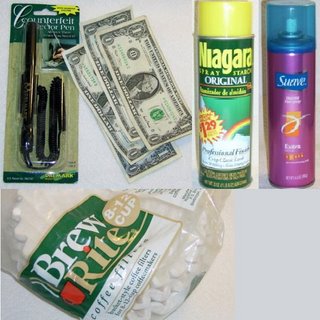
- DriMark Counterfeit Detector Pen with adhesive holder! (It was cheaper than purchasing 3 to a parcel.) Patent number 5,063,163 is proudly printed on the bottom of the parcel.
- Dollar bills. I used four singles instead of twenties, fifties or hundreds for two reasons. First, I'll be writing on these bills with a counterfeit detection pen, and I don't want a cashier to decline my money because they think it'southward funny. Second, I'g non so rich that I can play with hundred dollar bills!
- Starch. I could have used a powder starch and mixed information technology with water, but who needs that hassle? I used Niagara spray starch considering I'm familiar with it from using information technology every week for ten years while I was in the Air Forcefulness.
- Hair Spray. After a lot of idea I fabricated the scientific determination to use Suave unscented with Extra Agree. (Luckily I happened to accept a supply of this in my bath!)
- Computer paper, coffee filters, paper towels. Other sorts of newspaper to experiment on, and to use to clean up my mess afterwards.
- One domestic felines, admittedly required every bit an impartial observer and judge. My feline owner, a Mr. Samuel Francisco, (aka Cisco) was gracious enough to volunteer his services.
Method 
- Test the pen to make sure it can tell the difference between good money and figurer paper. This initial check also serves to prove that the pen is working as advertised. I applied the pen to one of the dollar bills and to a sheet of computer newspaper (folded in half).
- Apply spray starch to the next dollar bill in an endeavor to brand it read equally fake. Apply hairspray to the folded computer paper in an attempt to go far read every bit real. I used an evaporative rotary oscillator to facilitate in the drying of these sprays.
- Later on drying, exam the results past re-applying the counterfeit money detector pen to both the dollar and to the computer paper.
- Using the counterfeit coin detector pen, test a single coffee filter paper from the package of Brew Rite bargain filters that I found in my cupboard.
-
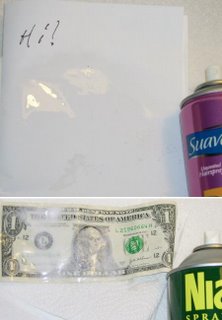 Spray some other java filter paper with starch and let to dry on the evaporative rotary oscillator.
 - Using the counterfeit money detector pen, test the coffee filter sprayed with starch to determine if it registers equally counterfeit or real.
- Using the dollar bill sprayed with starch from detail (2) to a higher place, spray this bill with hairspray and allow it to dry out.
- Test the nib with the counterfeit money detector pen to decide if information technology registers as false or real.
 Spray some other java filter paper with starch and let to dry on the evaporative rotary oscillator.

(Left) Testing the java filter
(Right)
Evaporative Rotary
Oscillator.
Not every lab has such loftier tech equipment!
Results
-
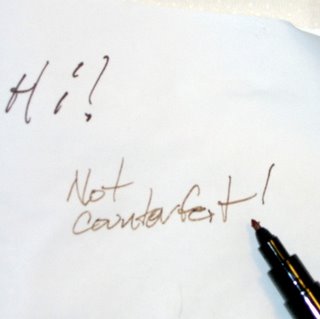
 Writing on coin is legal every bit long as I don't make information technology 'unfit for circulation' according to championship eighteen, Section 333 of the United States Code. Still I discover myself reluctant to write on information technology, so helpfully I write, "Not Fake" to put any receiving cashiers at ease. Writing on computer paper is easy except I accept a minor bit of writer's block, and so I just give a friendly 'Hullo!' The pen works as expected – the computer paper is fake coin, and the dollar bill is existent coin.
 - After spraying the beak with starch and the computer paper with hairspray I over again exam them both with the counterfeit detector pen. As predicted by James Randi, the second dollar bill at present reads as counterfeit. The pen at present indicates that the hairsprayed computer paper is genuine currency.
- I then tested a coffee filter with the counterfeit pen. The coffee filter is apparently made completely out of genuine American currency newspaper because the pen indicates that it is Not counterfeit.
- I sprayed a new coffee filter with starch and allowed it to dry on the evaporator. Afterwards I tested it with the counterfeit detector pen and constitute that the java filter now (correctly) reads as counterfeit paper. I have no idea what starch will do to my morning cup of coffee, just I'll bet it isn't anything good!
-
 At this betoken my neutral feline observer decided to preform a randoml quality command inspection while I worked, so I very carefully sprayed the previously starched beak with pilus spray under his scrutiny.
 - The starched dollar nib, sprayed with hairspray, is now very shiny in the camera wink, merely obviously NOT a counterfeit!
 Writing on coin is legal every bit long as I don't make information technology 'unfit for circulation' according to championship eighteen, Section 333 of the United States Code. Still I discover myself reluctant to write on information technology, so helpfully I write, "Not Fake" to put any receiving cashiers at ease. Writing on computer paper is easy except I accept a minor bit of writer's block, and so I just give a friendly 'Hullo!' The pen works as expected – the computer paper is fake coin, and the dollar bill is existent coin.
 At this betoken my neutral feline observer decided to preform a randoml quality command inspection while I worked, so I very carefully sprayed the previously starched beak with pilus spray under his scrutiny.
(Annotation that I used the word 'skeptic' with a comforting smily face on the dollar bill instead of the discussion 'false' or 'counterfeit'. No sense in making cashiers nervous!)
 Here is a bill that was sprayed with starch, then with hairspray. It 'failed' and registered every bit counterfeit after beingness sprayed with starch, and and then it 'passed' and registers as real money after being sprayed with hairspray.
This treatment results in a bill that has become 'slick' in experience, and somewhat glossy in photos.
The 'Skeptic' and smily face became a bit smeared after the awarding of hair spray. Possibly I used a scrap much?
 Mr. Samuel Francisco inspects the experiment and gives it his qualified approval before demanding his payment in tinned cubed chicken $.25.
Notes:
- During this test I accidentally marked i of the paper towels with the counterfeit detector pen, and found out that it was also plainly composed of genuine currency. I did not examination these newspaper towels with starch or hairspray because I learned during cleanup that the starch made them very soggy.
- At commencement I used the spray on, rub dry method of drying the dollar bills later applying starch, but the beginning bill I tried this on indicated as 'not counterfeit' after rubbing with a newspaper towel. It is my assumption that I didn't allow enough fourth dimension for the starch to soak into the beak. All further bills were allowed to dry without interference. The rubbed beak was removed from the experiment.
Discussion:
Every bit y'all tin see from the pictures, under normal circumstances the counterfeit detector pen is able to tell the deviation between computer newspaper and currency. It is Non able to tell the difference between coffee filters and real money. (Or newspaper towels either.)
The counterfeit detector pen will bespeak that money sprayed with starch is counterfeit. This is due to the reaction betwixt the iodine in the pen and the starch on the paper. The computer paper sprayed with hairspray is detected as genuine currency because the hairspray creates a barrier between the iodine in the pen and the starch that is used as a binding agent in the paper.
Some types of paper practice not contain starch as a bounden agent. Since starch is dissolvable in water, I guess it would be bad for coffee filters or newspaper towels to be held together with something that would cause them to fall apart during their normal usage. It may also be possible that starch would adversely affect the quality of java if it were added during the coffee-making process.
Adding starch to coffee filter newspaper makes information technology annals equally counterfeit because the iodine in the detector pen reacts to the added starch.
A dollar bill coated with starch and then sprayed with hair spray will be detected as genuine currency by the pen due to the hairspray barrier between the iodine in the pen and the starch on the bill.
Every bit a side bear upon, spraying bills with starch makes them feel a little more 'slick' to my fingers. Spraying them with hairspray makes them experience more than 'fuzzy'. Nether a photographic camera wink they get very reflective, but look normal under regular lighting.
Conclusion:
A few weeks ago I fabricated the mistake of leaving my wallet in my pants, which so went through the wash. Luckily I don't use starch in my wash anymore. (I did when I was in the military.) If you exercise utilise starch in your wash, and happen to wash an extra twenty, 50 or hundred dollar bill in your pocket, and then you are in danger of having that pecker flagged as 'counterfeit' by DriMark's pen. Luckily, you can make your bill 'good' once again by just spraying it with hairspray!
Counterfeiters who use a light amplification by stimulated emission of radiation printer to print fake bills on computer paper could brand all their bills adequate to cashiers who rely on DriMark'southward pen by adding a coating of hairspray.
In my opinion, counterfeit coin detection pens are a scam because DriMark can overcharge the user for cheap iodine. The price of these pens is much higher than the toll of an equivalent corporeality of iodine.
I purchased this pen for $four from Office Depot. Co-ordinate to the patent, the counterfeit detector pen is composed of 0.5 to 2.0% iodine. An eight ounce bottle of 10% iodine solution is $12 from Walgreens. If diluted to the proper consistency I predict that the bottle of iodine will exist in apply long after four DriMark pens have evaporated to uselessness.
I believe that counterfeit money detection pens are a dangerous scam due to the blind faith that most cashiers have in their ability to discover phony money. Counterfeiters who take the fourth dimension to create funny money volition certainly take the time to defeat these pens. I would judge that counterfeiters actively await for cashiers who rely on these pens because these cashiers are an 'easy target' for disposing of fake bills.
Source: http://calladus.blogspot.com/2006/09/testing-counterfeit-money-detector-pen.html
Posted by: boothebetiour.blogspot.com
0 Response to "Does Spraing Hairspray Paper Make It Work Like Real Money Paper"
Post a Comment